Spreadsheets → Web Apps
Your Spreadsheets are
Your App Studio.
Turn the spreadsheets you already know into full-stack web applications. Design forms, validation rules, and security logic instantly—No Code, No Prompt, No LLM required.
If you can structure a spreadsheet, you can build a web app.
How to think about it
Your workbook is the blueprint —
not the database.
SheetApps reads your Excel workbook the way a builder reads an architect's drawing. Sheets describe the application you want:
Form_sheets become data-entry forms — fields, sections, line items.List_ / Master_sheets become master data that backs dropdown fields.Rules_rows become field validations, conditional logic and business keys.Formula_rows become computed fields, updated live as your team types.
The cell values in your sheets are not imported as records. A new app starts empty: your team enters data in the app — or bulk-imports it — where every row is validated, secured and audited. Your Excel file stays what it always was: the design document.
How it works
Spreadsheets in, full-stack app out.
- 1
Design in Excel
Lay out your application as ordinary sheets: Form_ tabs for input forms, List_ tabs for master data, Rules_ for validations and conditional logic, Formula_ for calculations. No new tool to learn — the spreadsheet is the designer.
- 2
Upload & review
SheetApps reads the blueprint and shows you the generated schema — every field, data type, dropdown and rule it detected. Confirm, and the app is live with its own database, ready for your team.
- 3
Share & work
Invite teammates with roles, enter records in validated forms or bulk-import them, and export to Excel, CSV or JSON any time. Update the design later by uploading a revised workbook — records are preserved.
Almost zero build time
SheetApps builds your app the moment you upload the workbook. There is nothing to compile, generate or wait on.
Rapid prototyping
Reshape a sheet, upload again, and iterate on the live app in minutes — your records are preserved each time.
Immediate time-to-value
Your team enters validated data the same day. No dev queue, no project plan, no waiting for a release.
See it work
Pick a demo and click through it at your own pace — no video to load, nothing to install.
 Interactive demo
From Spreadsheets to App
Upload the workbook you already have. SheetApps reads its tabs and builds a working web app — no code, no prompt, no LLM.
 Interactive demo
Workspace and Apps
Sign in in your language, run several independent apps under one workspace, invite teammates with roles, and get instant AI help — all in one place.
 Interactive demo
Out-of-the-box features
Forms, rules, dashboards, masked sensitive data and multi-language — all from the workbook, no code.
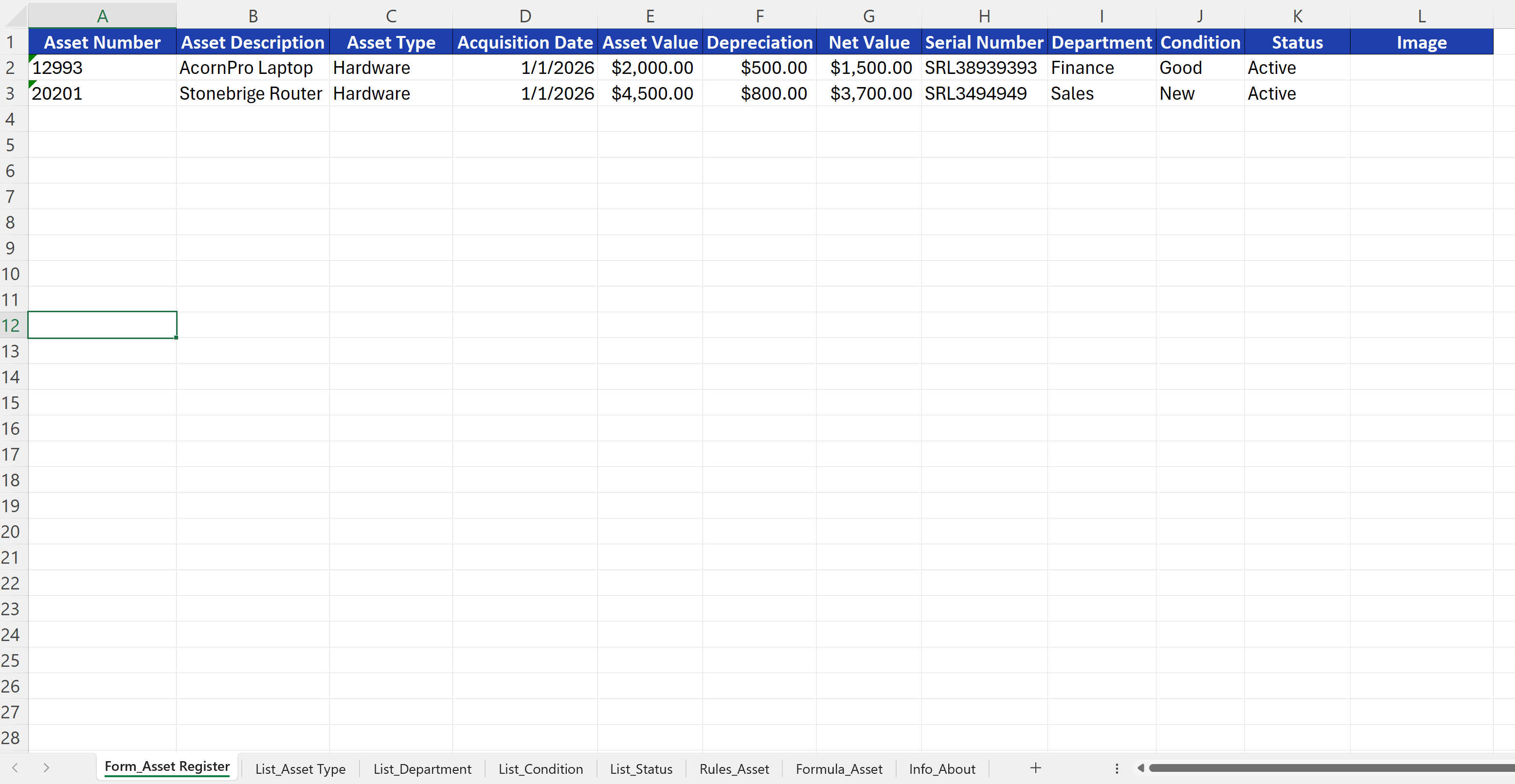
1. Start with an ordinary Excel workbook — here, an asset register with a column per field.
The workbook you already have is the design; there is no new tool to learn.
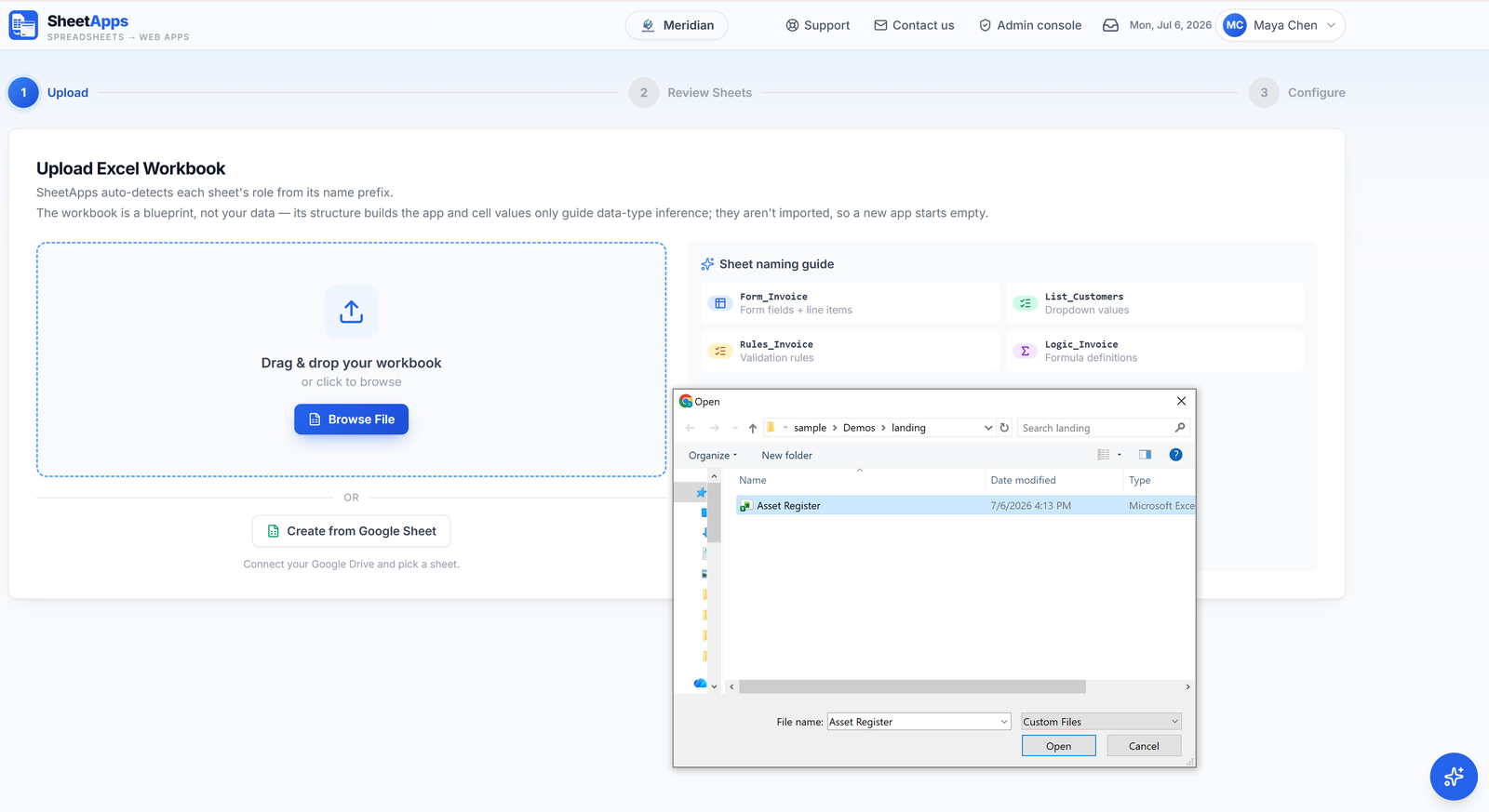
2. Drag the workbook into SheetApps, or browse for it.
It reads the blueprint in seconds — no code, no prompt, no LLM.
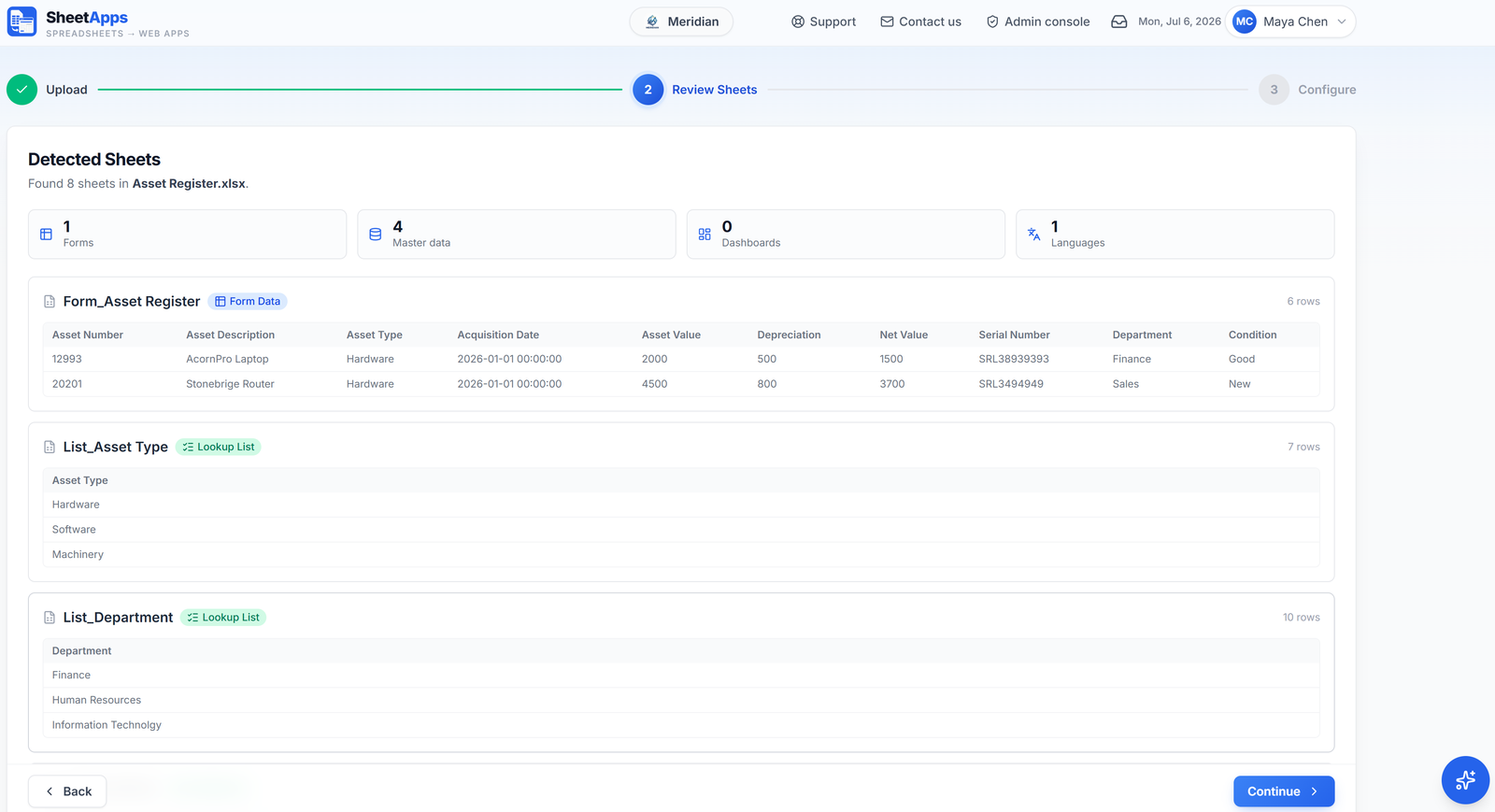
3. SheetApps shows what it found: one form, four lookup lists and a language.
Each tab’s role comes from its name — Form_, List_, Rules_, Formula_.
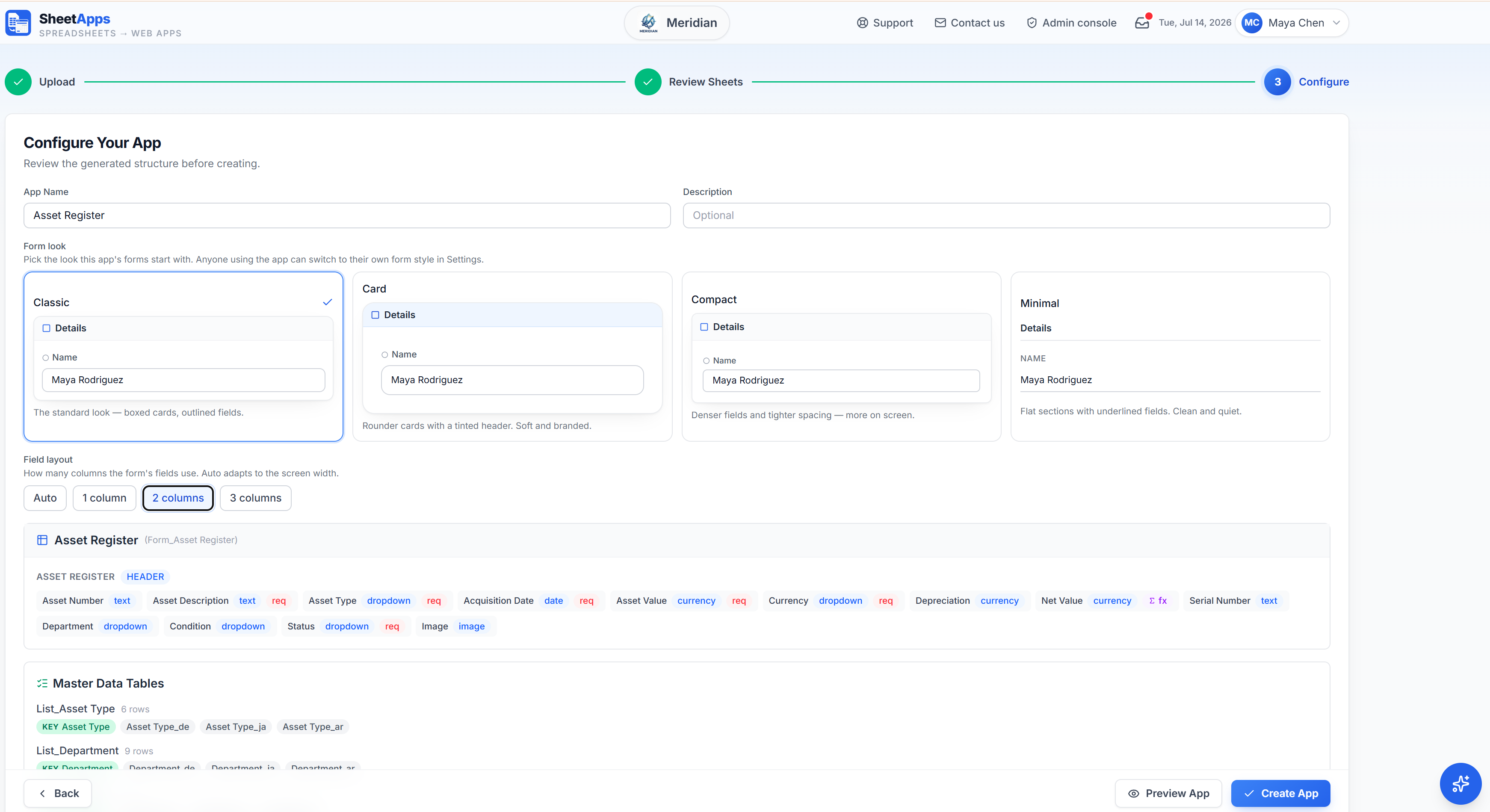
4. Check the fields, data types and rules it inferred, then pick a form look.
Text, dropdowns, currency, dates and formulas — all detected; adjust anything before you create.
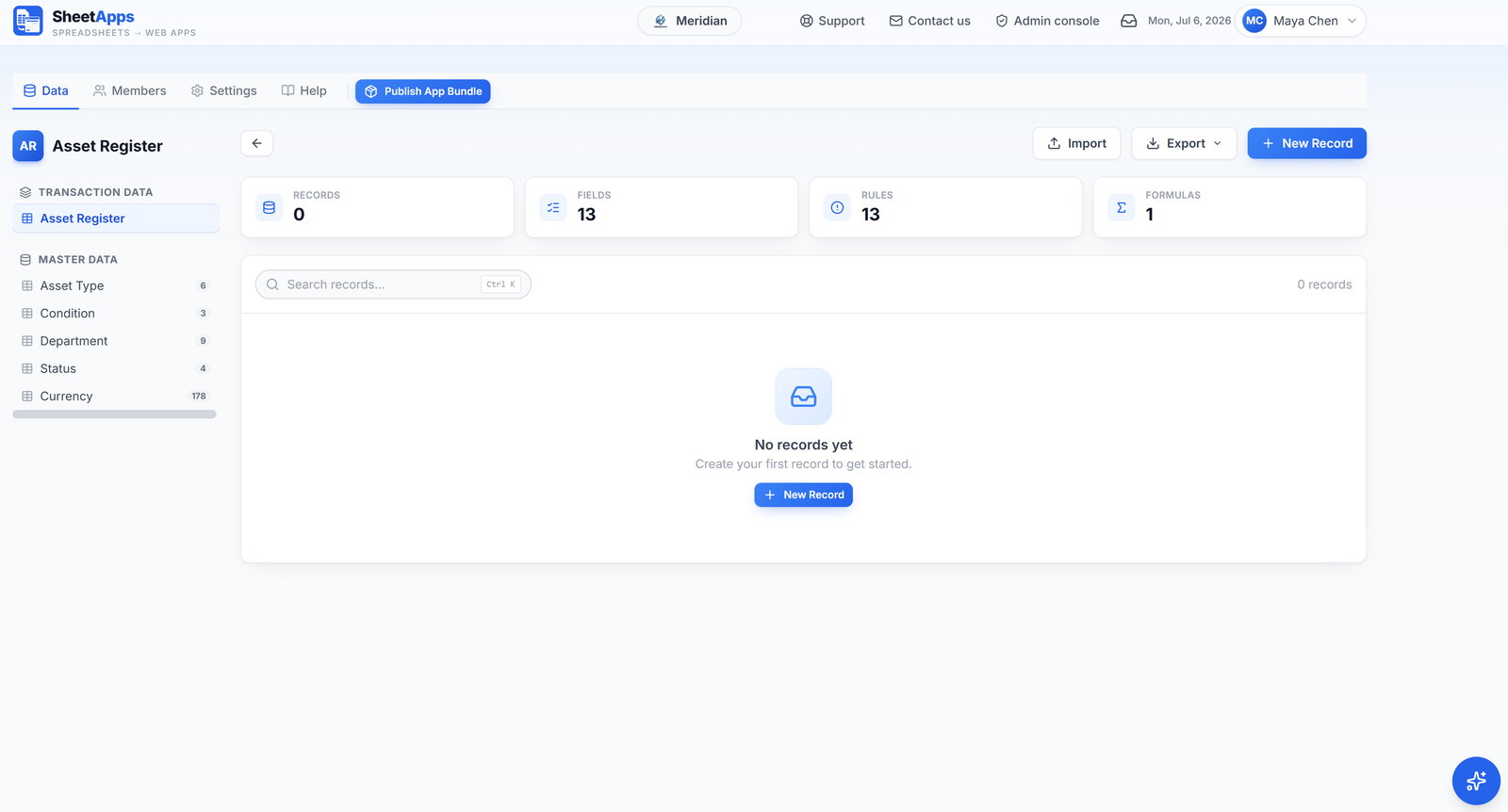
5. The Asset Register app is live with its own database — a form configured with fields, rules & validations, formulas and lookups.
Thirteen fields, thirteen rules and a formula, plus every lookup list as a dropdown source.
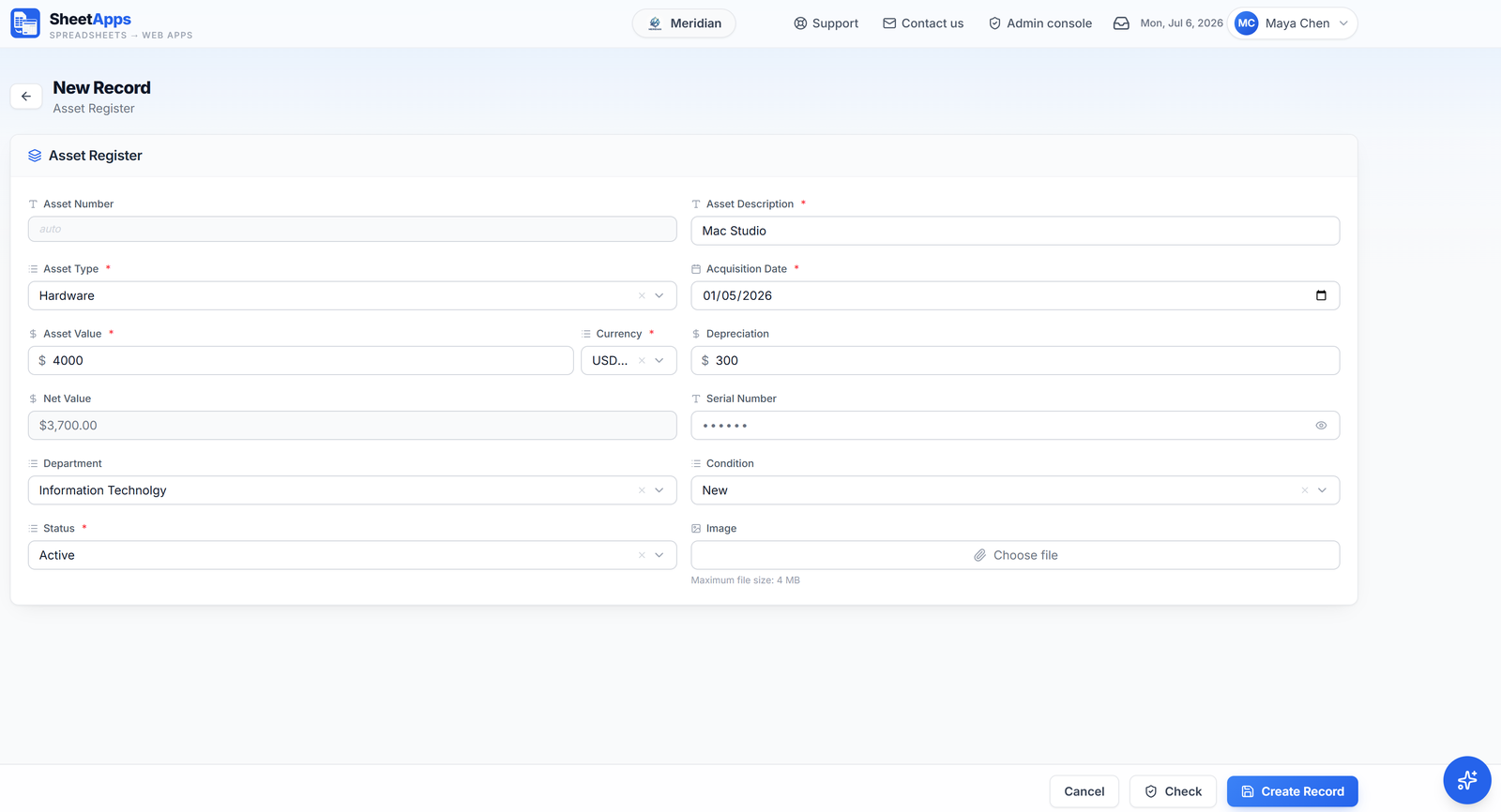
6. You can add records in a validated Asset Register form with dropdowns, required fields and live calculations.
In this form, Net Value is calculated automatically, Asset Number is auto-generated, Serial Number is masked and has multiple required fields.
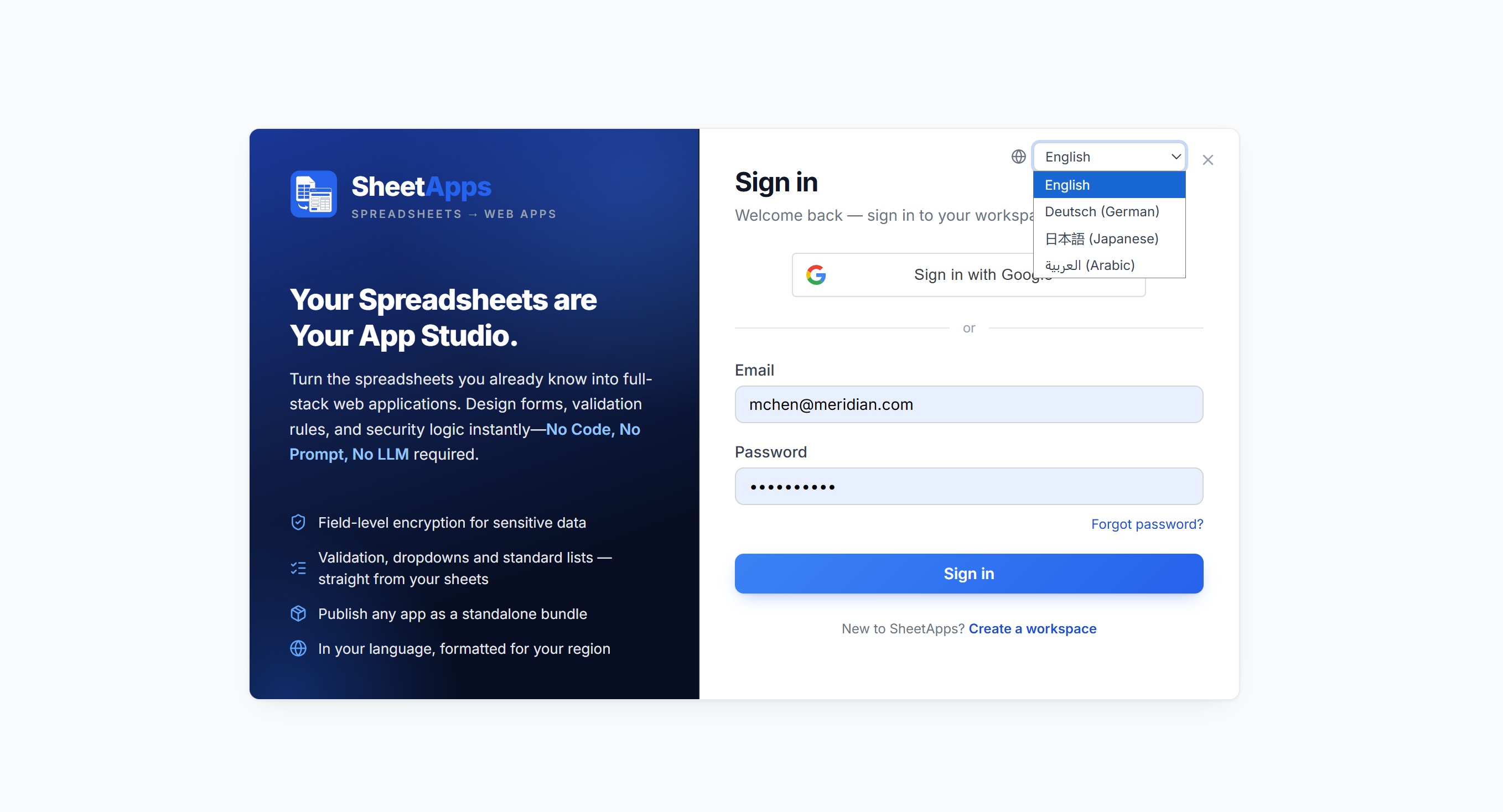
1. Sign in to your workspace — in your language.
SheetApps speaks English, German, Japanese and Arabic; choose yours right on the sign-in screen.
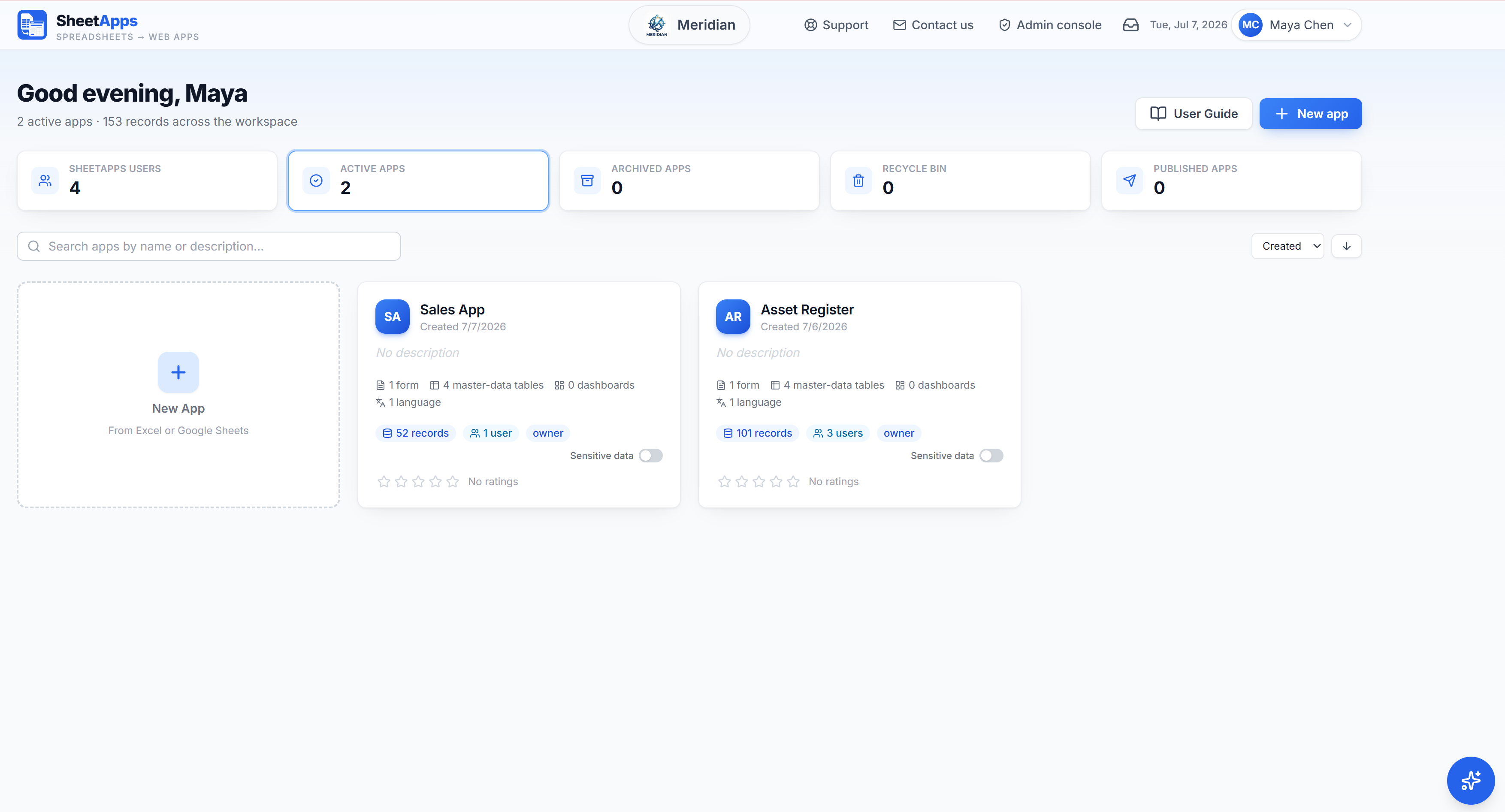
2. Your workspace home: your name, your logo, and every app at a glance.
153 records across 2 apps here — and each app is fully independent.
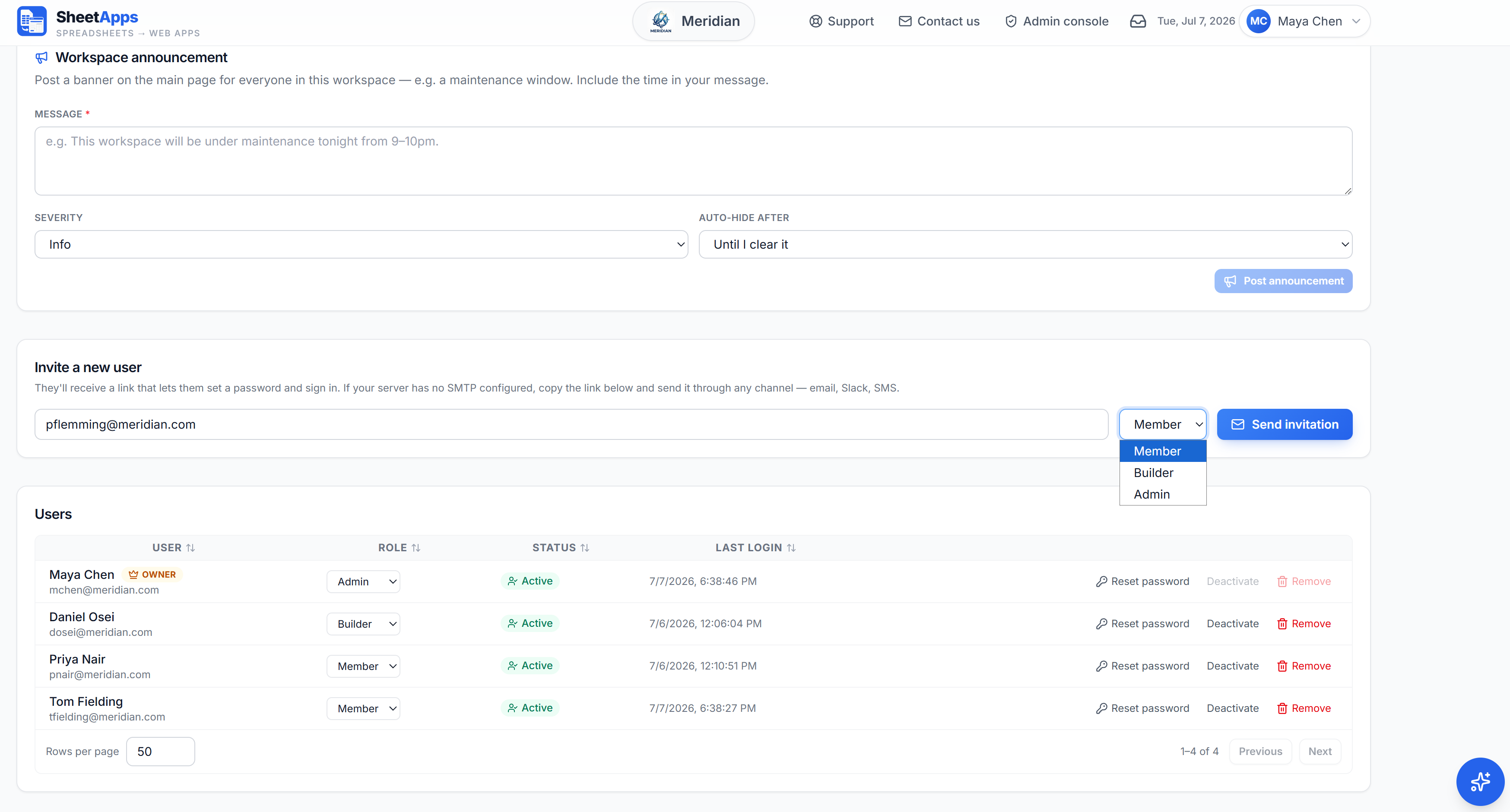
3. Invite teammates and give each a workspace role.
Admin, Builder or Member — sent as a secure link; no email server required.
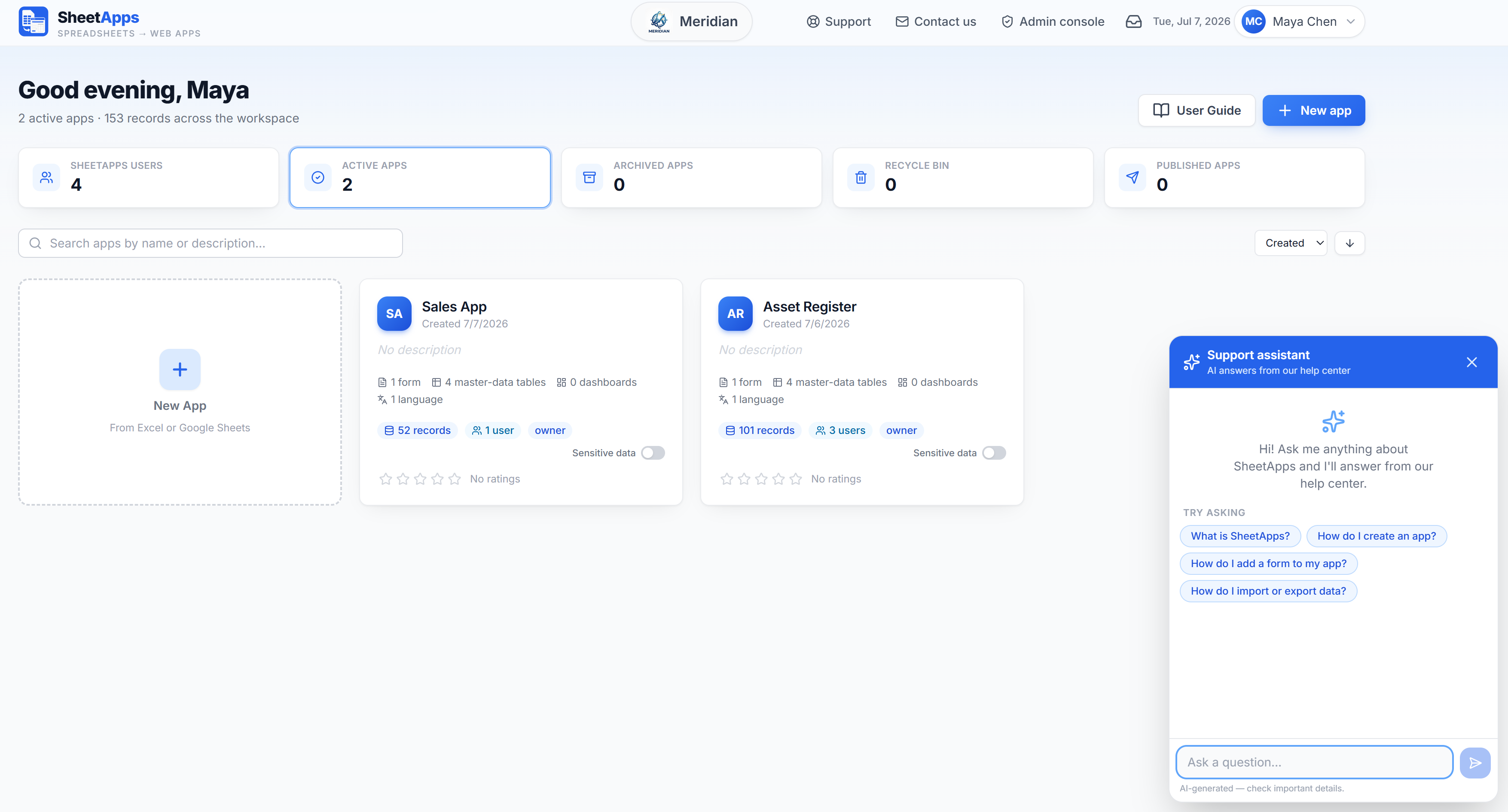
4. Stuck? The support assistant answers from the help center.
Ask anything about SheetApps and get an instant, cited answer — day or night.
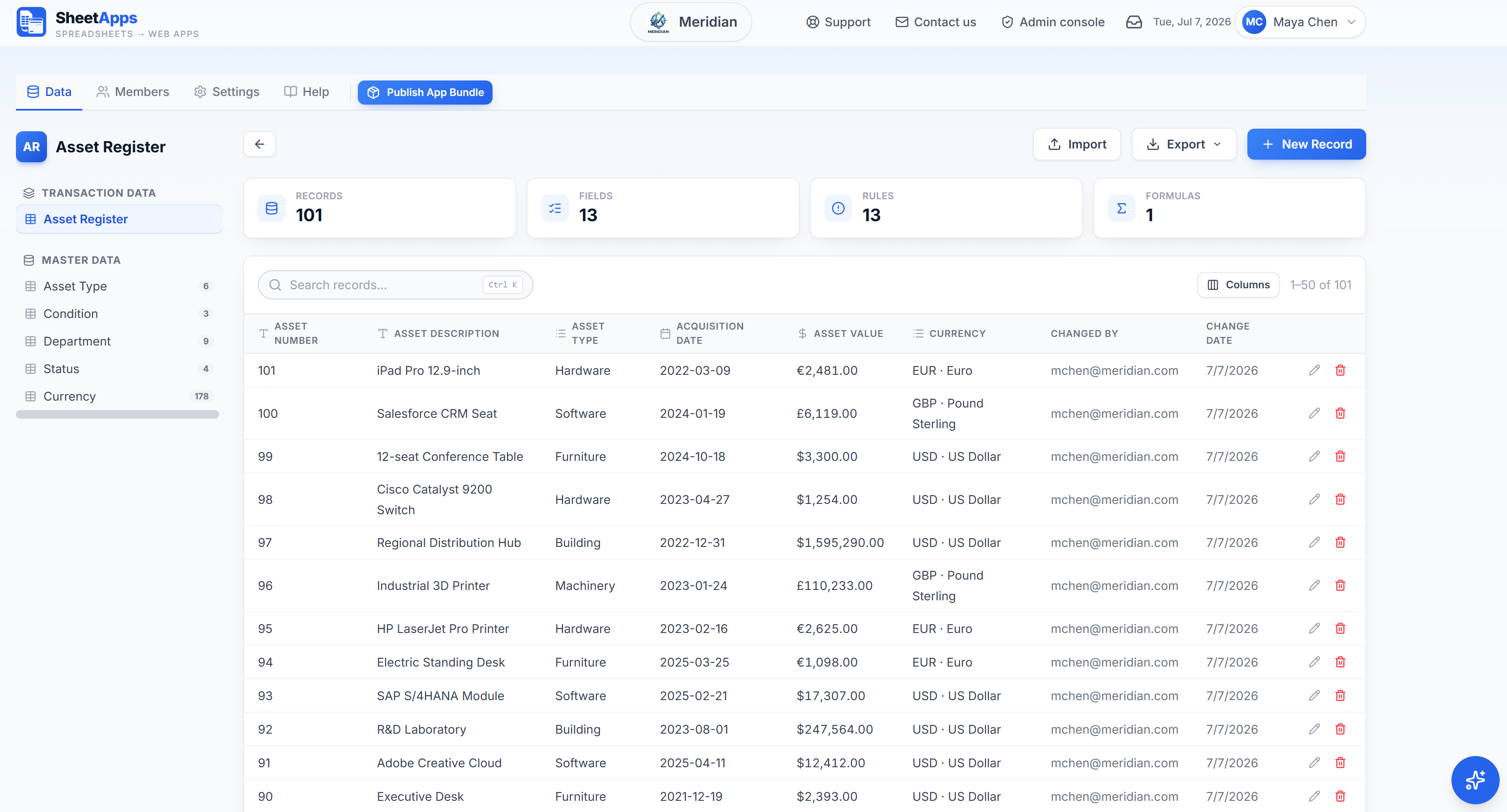
5. A real web app over your data — search, edit, import and export.
Live records with currencies and change history, ready to use.
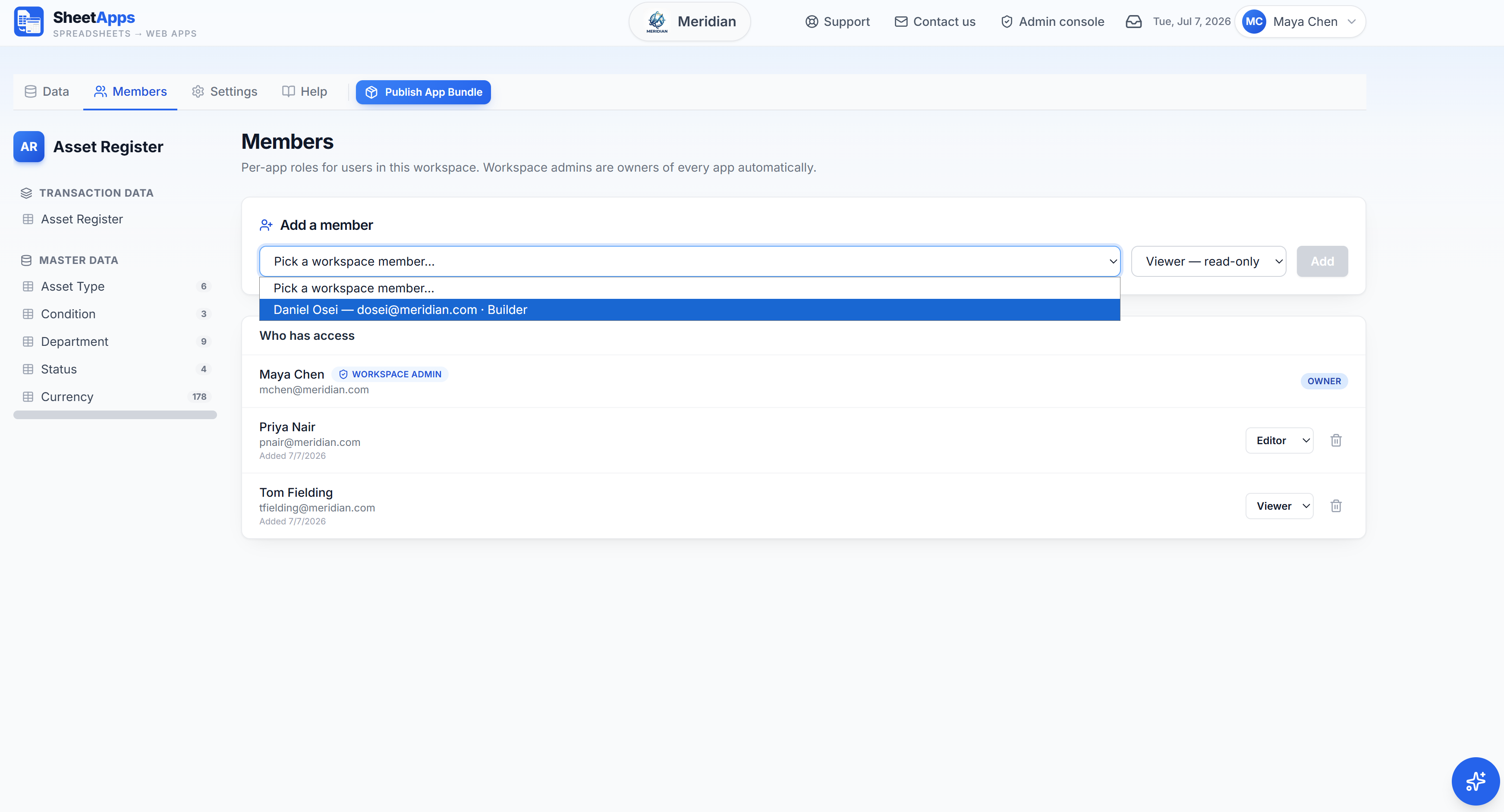
6. Assign per-app roles to control who can do what.
Owner, Editor or Viewer per app — workspace admins own every app automatically.
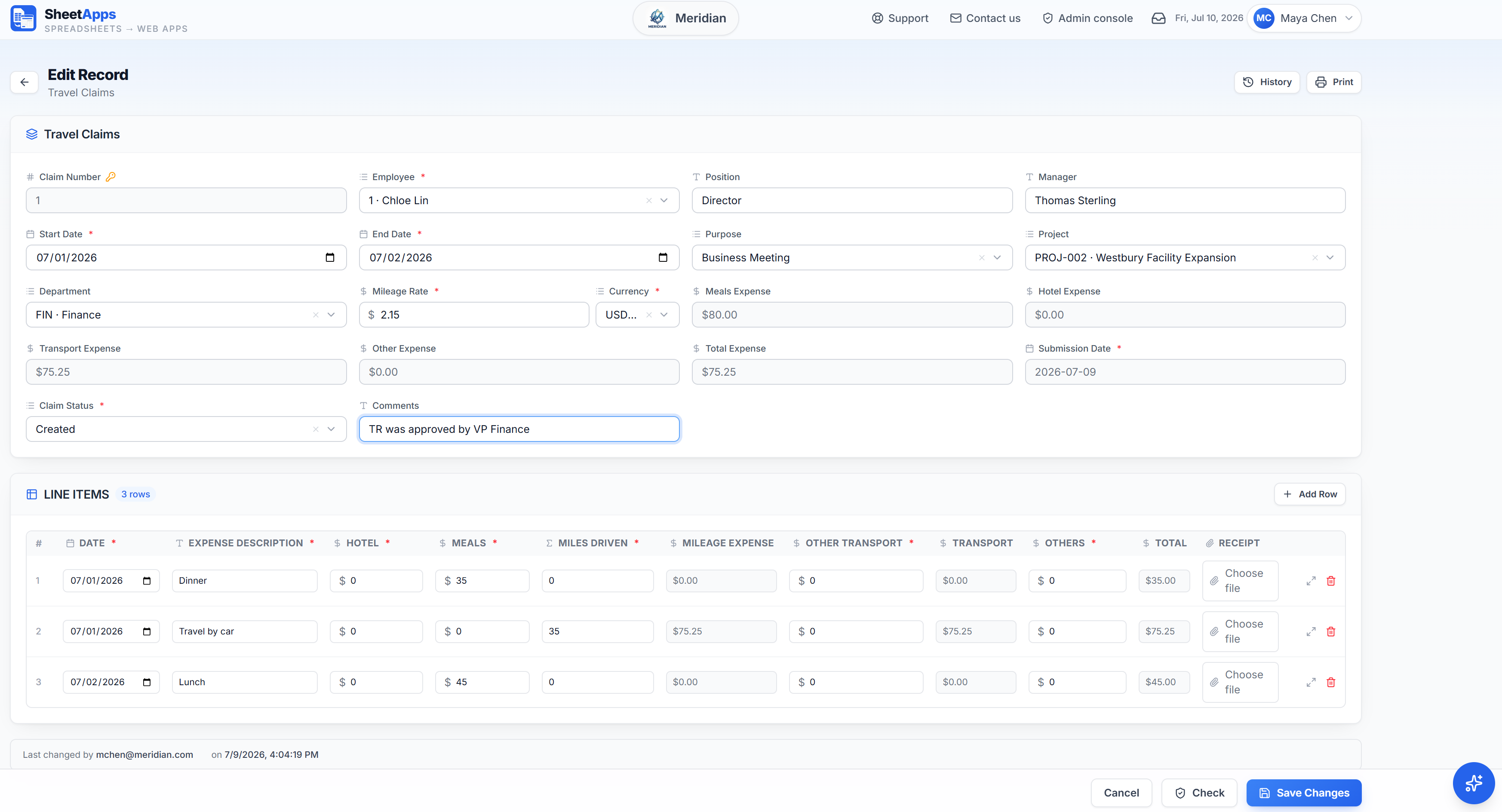
1. One form, many sections — header fields plus a line-items table, straight from the workbook.
Header totals recalculate from the line items as you type.
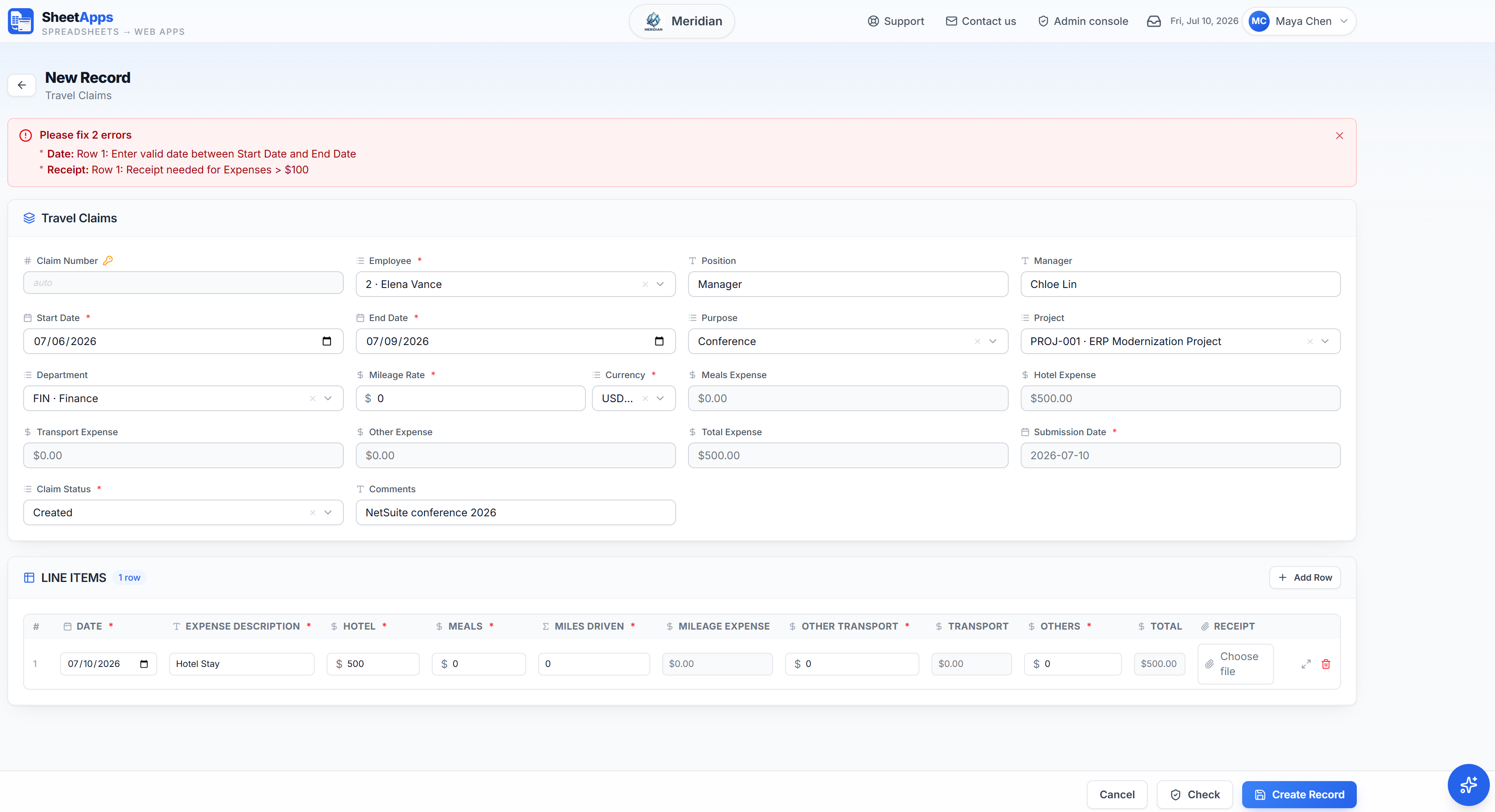
2. Workbook rules run on every entry — nothing invalid is ever saved.
Dates, required receipts, thresholds — written in plain language in the Rules sheet.
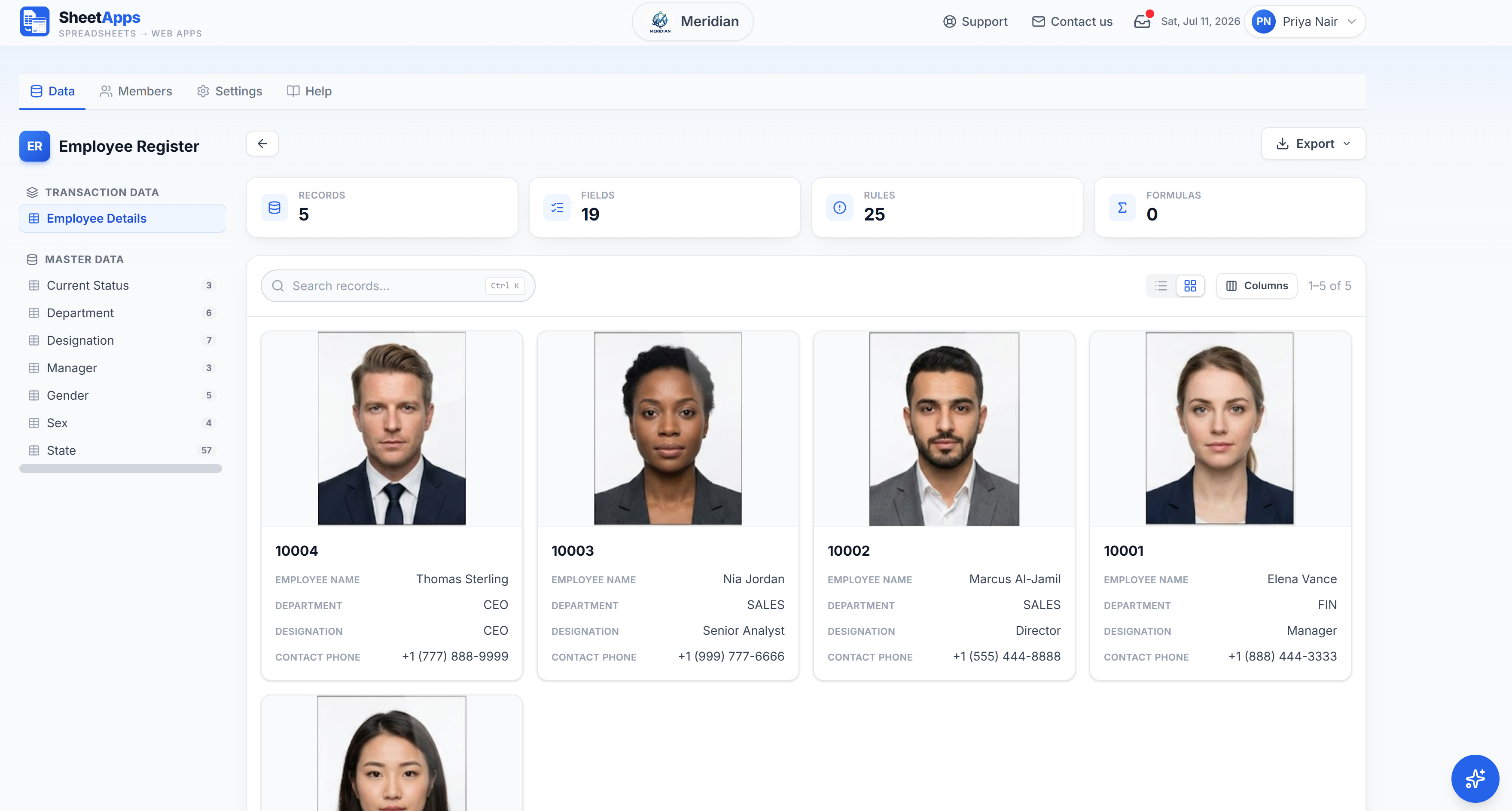
3. Records display as a dense list or as image-led tiles — one click to switch.
Tiles lead with the record's photo; the list stays compact for scanning.
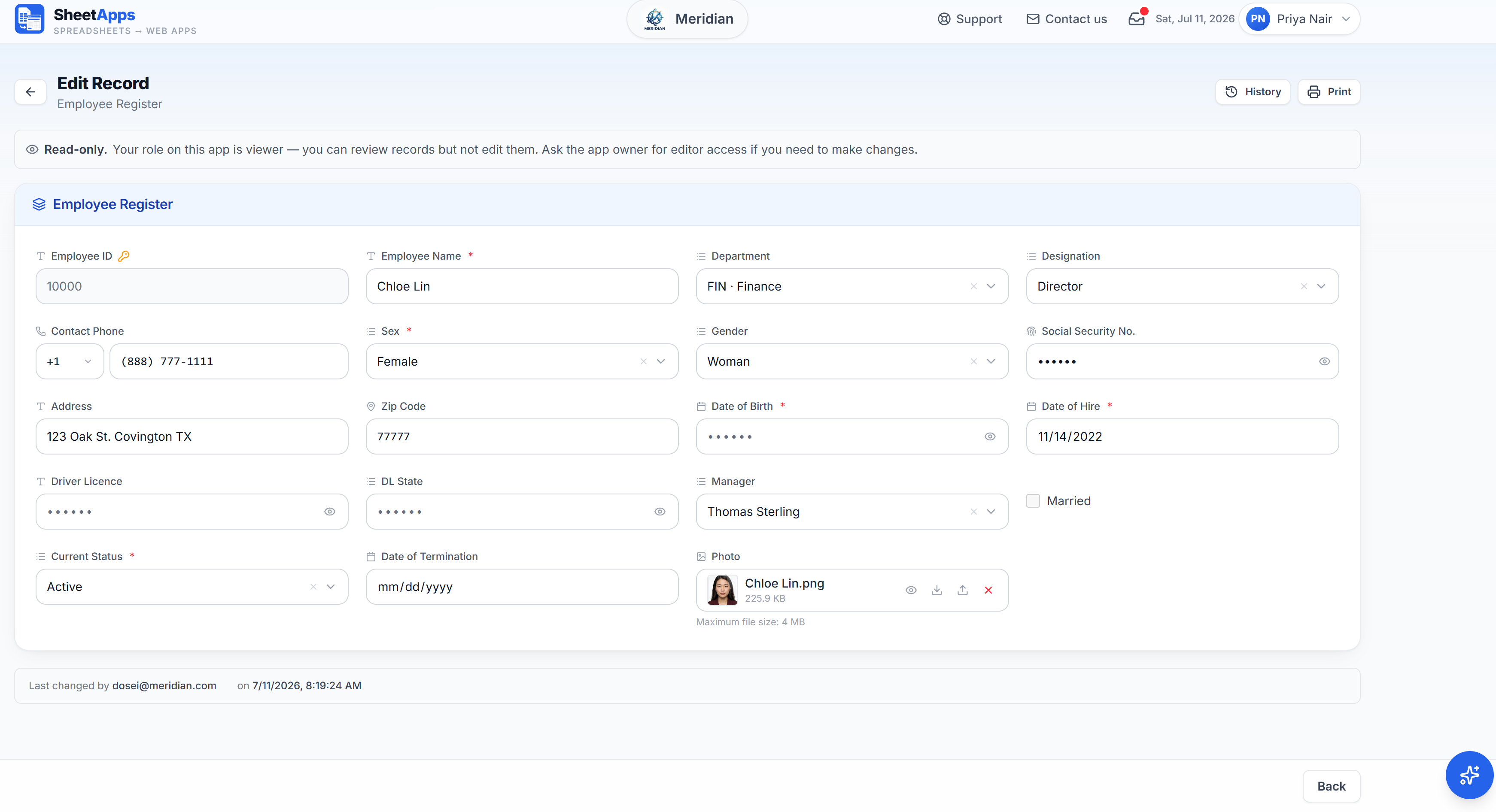
4. Mark fields sensitive in the workbook — viewers see masks, never the values.
The mask is applied on the server, so the real values never reach a viewer's browser.
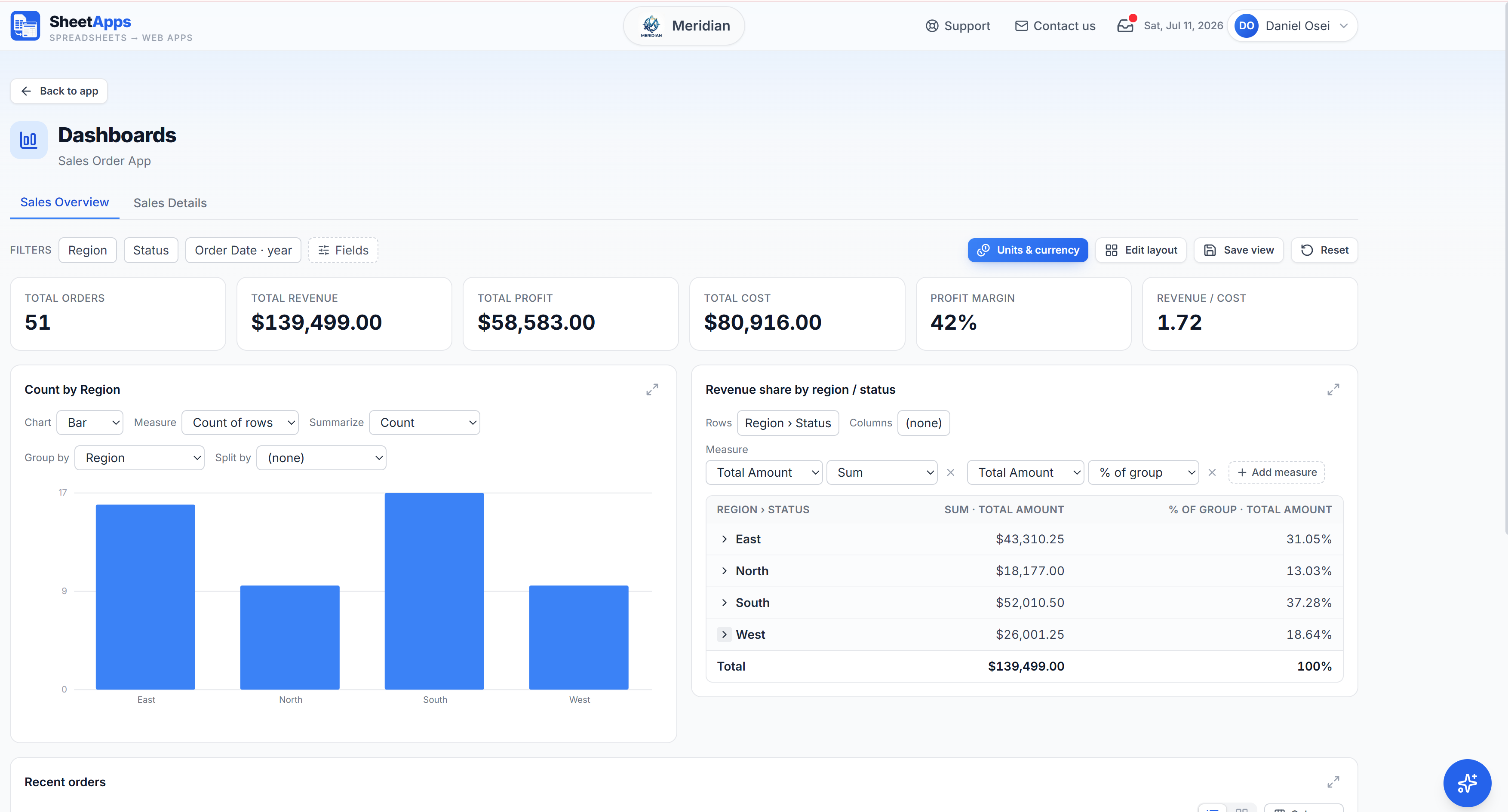
5. A Report_ sheet becomes live KPI tiles, charts and pivots — no BI tool needed.
Filter, drill down and rearrange; every viewer can save their own layout.
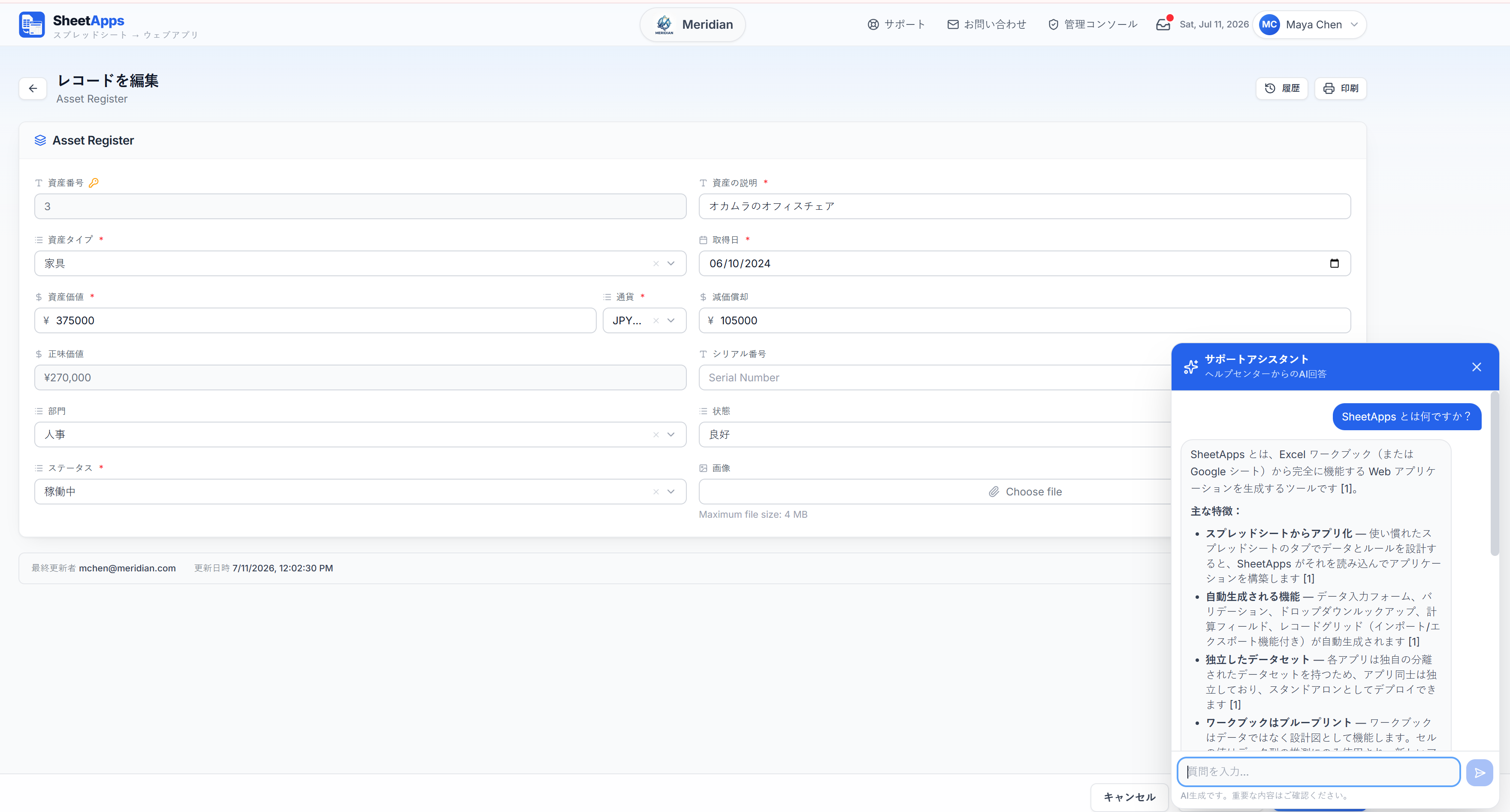
6. Ship the same app in several languages from one workbook.
UI, field labels and master data all switch with the viewer's language.
Features
Everything a real app needs — designed in cells.
The parts of an application that usually need a developer are exactly the parts your workbook already describes.
Validated forms
Required fields, formats with check digits (SSN, phone, UPC, routing numbers), ranges and conditional rules — straight from your Rules_ sheet, enforced on every save.
Dropdowns & standard lists
Master-data sheets become dropdowns, plus nine built-in standard lists — countries, states, currencies, languages, time zones and more — no lookup sheet needed.
Live formulas
Formula_ rows become computed fields that update as your team types — totals, derived values, auto-filled fields.
Multi-form apps
Several Form_ sheets become one app with multiple pages, headers with repeating line items, and per-form record grids.
Dashboards & analytics
Add a Report_ sheet and your app gets KPI tiles, an interactive pivot and charts — filter, drill down and save your view. No separate BI tool required.
Import & export
Excel, CSV, JSON and Google Sheets — exports round-trip back as imports, and business keys update rows in place instead of duplicating them.
Roles & workspaces
Invite teammates as admins, editors or viewers. Each app lives in a workspace with per-app membership and an audit trail of every change.
File attachments
Attach files to records with safe in-browser previews for images, PDFs and text — executable uploads are rejected outright.
Themes & branding
Four accent themes plus custom colors, light/dark/auto mode, layout density, and your company logo in the navbar.
Built-in AI assistant
A help assistant answers your team from your Knowledge Base and User Guide — grounded, cited, and private to your workspace.
Publish as a bundle
Any app can be published as a standalone, self-contained deployment that runs on your own server — data and all.
Multilingual & regional
SheetApps speaks your team’s language — the platform and your apps run in English, German, Japanese or Arabic (with right-to-left support), and dates, numbers and currency format automatically for each person’s region.
Security
On by default. Not a checkbox.
Spreadsheets full of personal data get emailed around. Apps built with SheetApps don't — sensitive fields are protected the moment your blueprint marks them.
Field-level encryption
Sensitive values are encrypted with AES-256-GCM before they reach the database, with per-app derived keys — the database provider never sees plaintext.
Card numbers: last 4 only
Credit-card fields are validated once, then stored truncated to their last four digits. The full number is never persisted — anywhere.
Masked by default
SSNs and card fields render masked with a reveal toggle, and exports mask them for every role unless an app owner explicitly opts in.
Support that can’t peek
Platform support sessions are read-only and never receive raw sensitive values — masking is enforced server-side, not in the UI.
Audited end to end
Every record carries who changed it and when; workspace-level actions land in an audit log the admin can review.
Backups & recovery
Scheduled backups, a recycle bin for deleted records, one-click export and non-destructive restore — your data is yours to keep and to get back.
Pricing
Start small. Change anytime.
Simple, fair pricing — a free tier plus paid plans. Full pricing will be published at launch.
Request early accessGet early access
SheetApps is opening soon. Tell us where to reach you and we'll invite you as we onboard the first workspaces.
That didn't work — please check your email address and try again.
FAQ
Questions, answered.
Does the data in my workbook become the app’s data?
No — and that’s by design. SheetApps reads your workbook as a blueprint: sheet layouts, field names, data types, lookup lists, rules and formulas. Cell values are only used as samples to infer each field’s type. A new app starts empty; your team enters records in the app or bulk-imports them, where every row is validated and audited.
Do my users need Excel?
No. Only the person designing the app touches a workbook. Everyone else uses a normal multi-user web application in their browser — forms, dropdowns, search, exports — on any device.
Can I change the design after the app exists?
Yes. Upload a revised workbook with the Change action: the schema migrates, existing records are preserved, and master-data lists are updated in place (matched rows update, new rows insert — manual additions survive).
Where does the app’s data live?
Each app gets its own isolated dataset. Sensitive fields are encrypted at the application layer before they reach the database, card numbers are stored last-4 only, and you can export everything to Excel, CSV or JSON whenever you want.
Can I run an app on my own server?
Yes — any app can be published as a standalone bundle: a self-contained deployment with its data, ready to run on your own infrastructure, independent of SheetApps hosting.
What skills do I need?
If you can structure a spreadsheet — name columns, keep a lookup tab, write a simple rule — you can build a full-stack web app. There is no code, no SQL and no devops in the workflow.
Can my app work in other languages and regions?
Yes. SheetApps itself runs in English, German, Japanese or Arabic — pick your language at sign-in or in Settings, with right-to-left support for Arabic. Each generated app can offer the languages you choose; anyone whose language an app doesn’t include simply sees it in English. And everywhere, dates, numbers and currency display in each viewer’s own regional format, while the stored data stays standard.